
Problem frame
When the drivers stay hidden, programs inherit weak logic — and resources follow the wrong priorities.
- Key drivers stay hidden, so resources follow the wrong priorities.
- Assumptions go untested, so decisions default to opinion.
- The rationale is scattered, so “why this?” is hard to answer.
- Updates are hard, so the work goes stale.
- Shared understanding is missing — multiple perspectives, no structured comparison.
We make the drivers visible and traceable, so you can align on priorities before money and effort get locked in.
Solution - a repeatable workflow —
not a one-off diagram.
We make the drivers visible and traceable, so you can align on priorities before money and effort get locked in.
- Step 1
Frame the question
Align on what decision this needs to support. Set boundaries (what’s in/out). Agree what “useful clarity” looks like for the people who will use it.
- Step 2
Build the evidence base
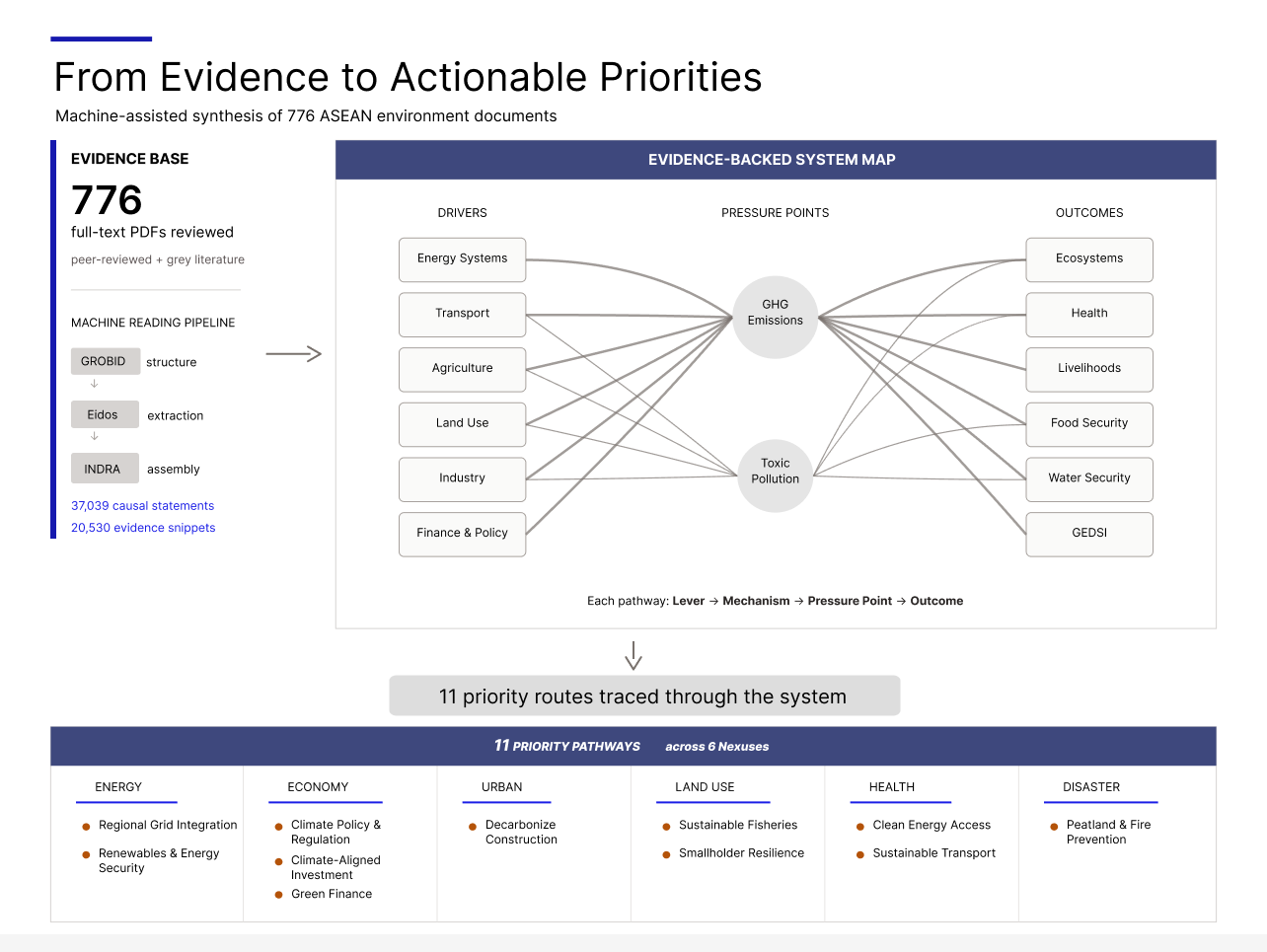
Run a structured search and screening process to assemble a deep, domain-wide body of sources. Add your internal material. Index everything so key claims stay findable and reusable.
- Step 3
Build the system map
Pull out cause-and-effect statements from the evidence (“what influences what”). Organize them into a consistent set of factors and connections. Track where support is strong across many sources versus more conditional.
- Step 4
Stress-test and set priorities:
Review the map with the people closest to the system to confirm what holds and what’s missing. Then translate the validated structure into a short list of decision-ready priorities—what to focus on first, why, and what evidence to check next.
What you get
Get in Touch
Send a note to quickly confirm fit and next steps.
After a 20–30 minute scoping call, you receive a one-page scope memo: recommended option, outputs, timeline, and a clear costed plan—ready for internal briefing.